The following is the text of a sermon I recently delivered while on a brief visit to the US. It concerns the orphan spirit that I suggested is not only responsible for the tremendous problem of orphans in Russian, but goes throughout society as a whole. Moreover, I suggested that it is a deep and growing problem in the US as well.
Presbyterians
love to exegete the Bible. I love to exegete people. Before I moved with my
family to Russia 5 years ago, I was a Christian counselor. Understanding what
the Bible says about how we tick, and how to pick the ticks off of us, as it
were, has been a quest of mine for about 20 years now. When you move to another
culture, you see your new culture at first through the eyes of your home
culture, but eventually the follower of Christ has to start evaluating what he
observes against a biblical grid instead. And so we find that every culture has
aspects of it that are more or less God-honoring, and those that are not.
What
originally drew us to Russia was one of its most glaring sore spots: the
tremendous problem with orphans. There are of course many countries who suffer
with large numbers of uncared-for children, and I began to ask myself what it
was that created the spiritual conditions necessary to allow Russia to have a
problem so large today, that it actually rivals the numbers of orphans present
after WW2. And this despite the numbers of institutional orphans going down.
95% of Russian orphans are what are called "social orphans," which is
to say that they may have a living parent, but parental rights have been terminated
or even voluntarily given up.
Foster
care is quite uncommon, though growing slowly thanks to some government
initiatives. Neither adoption nor foster care is a cultural value to Russians,
and those that do, sadly enough, fail to manage the challenges all too often:
Russians love to criticize Americans when they hear of abuse, neglect, or the
famous case of returning a boy back by plane. Little do most of them know that
in one two year period, 2008-09, 30,000 children were returned back to the
system.
You can't
have these kinds of problems in a vacuum. For every family that cannot or will
not raise its own children, there must be many more who are barely managing.
There must be many more who manage, but with various levels of dysfunction. So
I began to see that there was a biblical explanation for this trend: the orphan
spirit.
Now of
course there is no such exact term in the Bible, but it comes close enough.
What we do find is:
•
a
spirit of fear or timidity (2Tim. 1:7)
•
a
spirit of slavery (Ro. 8:15)
•
a
spirit of adoption (Ro. 8:15)
Of course
the first two are not from God, and the latter is. What ties the spirit of fear
and the sprit of slavery together is found in Heb. 2:15. Fear of death subjects
you to slavery. And all fear at its root is a kind of fear of death.
Chemically, the brain has two classes of chemicals: fear based and love based.
Every emotion and every thought related to those thoughts are driven by one or
the other. The one is quite destructive to our bodies, and the other is not
only healthy but actually regenerative in power - an amazing confirmation of
biblical truth.
Paul
develops the whole theme of slavery starting in Romans 6, and concludes his
argument in chapter 8, verse 17,
by saying that "if we are children, we are heirs - heirs of God and
co-heirs with Christ, if indeed we share in his sufferings, in order that we
may also share in his glory.
So
putting all this together, we see that we may share in God's glory by sharing
in his sufferings, which comes from being an heir, which comes from being his
child, which comes from renouncing a spirit of slavery, which comes from
rejecting a spirit of fear. I say this not to give you a formula, for God's
grace is much more mysterious than that, but to help you understand that the
essential nature of the person outside of Christ, is one of fear, which makes
him a slave to those fears. This is what I am calling the orphan spirit.
Why
indeed does God insist so many times throughout the Old Testament, and repeat
it in the New, that our care for orphans is a critical indicator of our love
and devotion to God? Is it because God is a bleeding-heart liberal who just
feels bad for the kids? Well, I think God's heart does break for the kids, but
the real reason seems to go deeper than this. It's because we were all orphans,
dominated by fear before turning to Christ, and God's heart is for us. This is
why John says you can't say you love God and not love your brother. You
literally can't love God and not love orphans. God told the Israelites to care
for the resident aliens in their land because they were once resident aliens in
Egypt. So therefore we care for orphans because "there but by the grace of
God go I."
And
America can't say it's got all that much grace going for it right now either. I
don't need to quote to you statistics on abortion, divorce, and absentee
fathers to remind you how far we have fallen in the last generation. These are
all direct signs, in our culture, of the orphan spirit. Orphans overwhelmingly
reject their own children. And abortion is a rejection of your own flesh and
blood, and fathers who sire a child without remaining through thick and thin
have rejected their own flesh and blood. Only an orphan can do that. Why?
Because fear drives them to do it. Fear of the future, fear of finances, fear
of commitment, fear of rejection, etc. etc.
In
Russia, it's much worse in many respects. In my counseling training just a few
weeks ago I witnessed an amazing session where a woman named Irina came face to
face with the fact that her mother had had 26 abortions. She couldn't see how
she could possibly forgive her for being such a person, especially considering
that she herself was supposed to be one of those victims. But by the end she
did forgive, and the freedom it gave was as powerful as the bondage she had
been in to fear and condemnation beforehand.
Do you
think Russia is free of its Soviet legacy? How could it be when even today
people have parents and grandparents that were torn away in the middle of the
night by the secret police for no reason at all, other than to feed a slavery
economy unknown before in world history called the Gulag, because of the wild
aspirations of one demonically inspired man named Joseph Stalin. Fear was THE
main driving force of Soviet society for over 70 years, although most
particularly during Stalin's rule from 1924-1953. Families were destroyed
systematically, and men in particular have never recovered to this day. Alcohol
is not called spirits for no reason. It is a substitute for the work of the Holy
Spirit in Russian society. Seeing drunk men lying unconscious or even dead on
the streets is not something we were eager to expose our kids to, but they now
have a good picture every time it happens of why we are there.
Our
ministry is about restoring the hearts of the fathers to their children, which
is the great promise of the prophet Malachi. And this requires restoring a
sense of the Father heart of God. Let me read our main passage today and
discuss it briefly as a way of understanding my mission in Russia more fully.
Gal.
4:1-7. Now I say, as long as the heir is a child, he does not differ at all
from a slave although he is owner of everything,
2 but he
is under guardians and managers until the date set by the father.
3 So also
we, while we were children, were held in bondage under the elemental things of
the world.
4 But
when the fullness of the time came, God sent forth His Son, born of a woman,
born under the Law,
5 so that
He might redeem those who were under the Law, that we might receive the
adoption as sons.
6 Because
you are sons, God has sent forth the Spirit of His Son into our hearts, crying,
“Abba! Father!”
7
Therefore you are no longer a slave, but a son; and if a son, then an heir
through God.
From
verse 1 we see that the only difference between a slave and a son is the fact
that the son has something coming to him; he only doesn't have access to it
yet. The child is an heir, present tense, but he doesn't really know it. Or if
he does, it makes no practical difference to him. It's not that the child is a
foreigner and then becomes an heir. His parents knew his destiny from day one.
Score one point for the Calvinists.
But the
point is not about God's foreknowledge, but rather about His goodness in
providing a means of access to the goods. The guardians and managers of verse
two refers to the law and the prophets, which Paul later calls the tutor to
prepare us to be aware of our need for Christ. Our problem, as children, is
that we are under bondage to the ways of the world. We are born into a culture,
a time and space place, and we inherit the baggage of our environment. We are
not to blame for this fact, but we do bear one, but important, responsibility:
will we receive our adoption papers?
God
didn't just stamp our heavenly passport. He actually sent a Special Envoy,
uniquely qualified for the job, to go through all the red tape that getting
entangled in a sinful world entails, so that he could file the paperwork
necessary to buy our freedom from slavery, from the orphanage, if you will. And
in the process, just for wanting to give us that freedom, just for coming to
show his Father's love for us, just for wanting to buy us back from the auction
block, when we were sold like mere livestock to slavery to the Massa, just for
wanting to call us his Sons and Daughters, that Special Envoy from the King was
not only rejected, but brutally killed for what he came to do - for us.
The
ministry God has called me to do over these past five years has so far been
largely about helping to reverse cultural and personal lies that say that God
is not that good. We who grew up in America don't even realize all the
blessings we have from inheriting a country with many Judeo-Christian
assumptions about life and God. The typical Russian view of God is a very
distant OTHER, who is capricious and harsh, ready to punish with little to no
provocation. The result is a self perception that is full of shame and devoid
of hope. Americans talk of feeling guilty over something. Russians talk of
feeling shame. The difference is that guilt relates to behavior. Shame relates
to identity. Of course we should feel guilty over sin, and shame is an
appropriate response of one who has utterly turned away our Father's love. But
our earthly Massa doesn't want our guilt and shame to work to our benefit,
helping us to see the need for forgiveness and a new identity as a son. So I
have been training leaders in biblical counseling and in the use of prayer to
uncover and invite the Holy Spirit to replace lies with truth, which is the
only foundation of real change. It is a complete work of grace, initiated and
consummated by God, and we get to be co-laborers with Him.
Once we
have a person secure in their position with the Father as a son or daughter,
then change accelerates. Until then, orphans can have really unhealthy
attachments, or lack of attachments, to others. Blessed are the adoptive
parents who get their child at a young age - usually before the age of three.
For those raised in an orphanage in Eastern Europe or Russia, psychologists
have come up with a diagnosis called Reactive Attachment Disorder. According to
Wikipedia,
"The
core feature is severely inappropriate social relating.... This can manifest
itself in two ways:
•
Indiscriminate
and excessive attempts to receive comfort and affection from any available
adult, even relative strangers (older children and adolescents may also aim
attempts at peers)
•
Extreme
reluctance to initiate or accept comfort and affection, even from familiar
adults, especially when distressed"
This is
the phenomenon that makes Russian adoptive kids in America when they become
teenagers so volatile and difficult. As I have considered this phenomenon over
my several years in ministry, I have concluded that Reactive Attachment
Disorder is the essence of the orphan spirit. I say this in literal terms as it
relates to orphans, for it is unheard of outside of an orphanage background. It
is also apt as a description of fallen humanity's hopeless attempts to manage
life apart from a relationship with our true Father.
And
praise God, we are finding that these empty strategies simply vanish in the
lives of both the literal and spiritual orphans that we work with in Russia. I
think of Ludmilla, who has suffered all her life under the burden of shame and
guilt about her family life, feeling responsible for a host of problems outside
her control. When we found the root in how she perceived her father's rejection
of her, and she finally saw Jesus as giving her strength, love, and purpose,
she threw off everything that was hindering her, and the sin that had entangled
her, and she began to run the race with energy. Now she wants to start offering
herself and her artistic gifts in ministry to teenagers to help them connect
with the heart of the Father.
Verse 6
is the key verse. "Because you are sons, God has sent forth the Spirit of
His Son into our hearts, crying, 'Abba! Father!'" First, we see that God,
from His eternal perspective, sees who we are before we see it. He calls us
sons, and acts because of that fact. So based on who we are, who He has
determined and called us to be, he sends the Spirit. If only we would recognize
the power of this one fact - that we have the Spirit already in our hearts, how
many questions, doubts, and fears would vaporize in an instant. But we try to
talk God into doing something on our behalf, of giving us the Spirit, of
blessing us, of hearing our prayers (for crying out loud), when he has already
given us everything we need for life
and godliness through our knowledge of him who called us by his own glory and
goodness - according to 2Peter 1:3.
Biblically,
the heart is the seat of our spirit, and when we are born again, we are given a
new Spirit, since our spirit was completely dead, which is to say, cut off from
all hope of communication or communion with God. The word crying, from krazo (κραζο), signifies “a loud and earnest cry,” or “a public announcement.” Both of these meanings are
actually significant. That the Spirit is making an announcement of sorts is
attested to by the interesting connection with Roman adoptions, where the
presence of a witness was required. And the Holy Spirit was traditionally
associated with bearing witness to something. The more interesting aspect of
this word is the loud and earnest cry, which literally derives from an
onomatopoetic word describing the croaking sound a raven makes. That is to say
it's a deep guttural cry that comes from the core of a person's being. A young
woman, Yana, was sitting by merely witnessing some of the amazing transformation
that was taking place in Ludmilla's heart just before I left to fly here, and
something deep within just broke, and she began to weep like I have never seen
her weep, crying out to God for a restored relationship with her mother. She
had never even really wanted to be reconciled with her mother before that
moment. But being in the presence of the Spirit's activity was enough to cause
the fountains of the deep to open up, and the girls surrounded her in hugs and
prayers for many minutes in a beautiful moment of shared thanksgiving and
intercession.
I had
heard before that Abba is an informal term for Father, but I had to check it
out, to see if it wasn't some sort of post-modern spin, but multiple sources
confirmed to me the amazing, almost too-good-to-be-true meaning of this word.
Abba really is the Aramaic for the intimate term that we would translate best
as Daddy. Why this is so incredible is seen in the contrast with Jewish usage,
where it was acceptable from child to father, acceptable from adult father to
his aged father, but never acceptable in reference to God, although the more
formal term for Father was used for God. Jesus called God Abba, and Paul uses
the term himself, as though to confirm and underscore its significance.
So God
sends His Spirit to those who are His children, and this Spirit gives them the
ability to have a heart-felt connection with Him that is so deep and profound
that out of our inmost being can come a cry of "Daddy." This can
happen for those who had no daddy. This can happen for those whose father was
or is a terrible representation of God the Father. If you have a piece of
paper, write down the following word pairs:
1. potter - clay
2. shepherd - sheep
3. master - slave
4. father - son
5. friend - friend
6. bridegroom - bride
You
should recognize that all of these are biblical metaphors for our relationship
with God. Notice also that they are listed in order of growing intimacy.
Somebody should do a 6 part sermon series on each of these. I list them to show
that there are various levels of intimacy with God, and that not all of them
come naturally to each person. Even though our ultimate place is that of the
bride, a point most strongly underscored in Ephesians and Revelations, the most
frequent analogy used, and that by a long shot, is that of Father to son. My
guess is that once you really can say, "Daddy" from your heart (like
a crow!), then the rest will come. My ministry is focused like a laser beam on
bringing a revelation of this core truth to everyone in Russia who will receive
it. My own growing awareness of
God as my Daddy has impacted my personal walk with Christ, my sensitivity to my
wife as a husband, my love of my children as a father, and my depth of
interactions with people in ministry. May you start to connect more and more
deeply with the Spirit within you that is already crying, passionately crying,
Abba, Daddy.


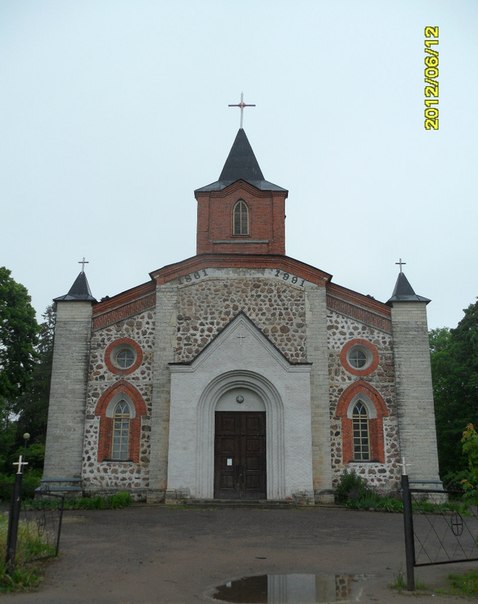
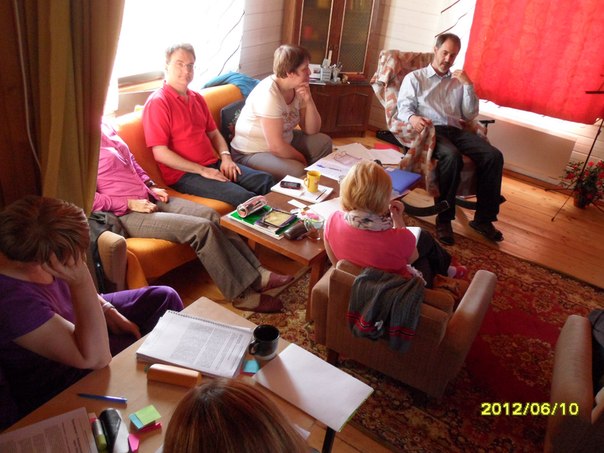 As if it were not enough to have had an intensive month of preparation for our counseling seminar last month, my team has a voracious apetite for growth, so we went on a retreat this month. The opportunity came up because my teammate in our mission CRM, Bill O'Byrne is preparing to leave for a one year sabbatical, and I wanted everyone to experience a seminar he leads that had a major impact on me four years ago called Discovery. (It's regularly offered in the US, btw.)